The Athena Complex

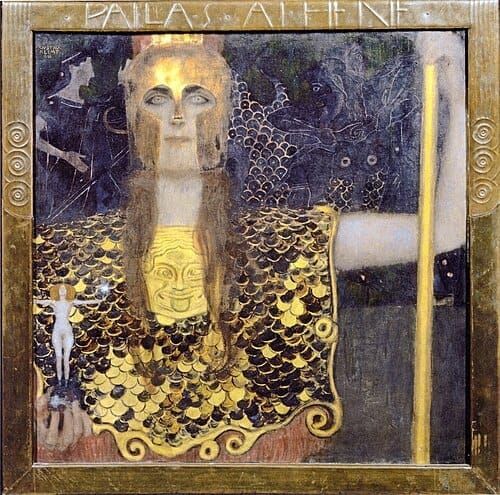
“Why Athena?” my mom asked recently. We were in my basement, turning part of it into a guest room. She’d just come upon a framed print of Klimt’s Pallas Athene, intended for my office but still sitting in the box.
“I’ve just . . . always liked Athena,” I replied after a beat, “she’s the goddess of knowledge.” (And war, though I try to ignore this part.)
She still seemed puzzled. I didn’t blame her. Because while I do like that Athena is the goddess of knowledge, it has nothing to do with why I feel so drawn to her. But I hadn’t wanted to tell my mom the real reason, because I hadn’t wanted to make her feel bad.
In 2025, a ninety-seven-year-old Santa Cruz tortoise named Mommy gave birth for the first time. Mommy eventually produced sixteen healthy hatchlings, the first four of which were all girls: Sophia, Dorothy, Blanche, and Rose. She wasn’t always called Mommy, the internet tells me, though I find nothing about what her name was before motherhood. As far as the world knows, she is only Mommy.
Mommy has been at the Philadelphia Zoo since 1932, stared at by generations of children; my own mother saw her on visits to the zoo in the 1950s. My brother, Josh, and I saw her, too, on countless school trips, decades before her babies were born. Mommy was thus new only to Leo, my then-four-year-old nephew, when we went to see her in April 2024. After a year filled with both death and divorce, we were a shrunken bunch: just my mom, my brother, Leo, Josh, and I.
Perhaps, looking at Mommy, my mother thought about her mother, who lived to ninety-eight. Or about herself, recently widowed. The women in my family live forever, frequently outliving male spouses by decades. My body, though, is such an exact copy of my father’s that I doubt my longevity more than I once did.
Do you know the story about Descartes’s daughter? It goes like this: the death of Rene Descartes’s five-year-old daughter, Francine, left the philosopher so bereft that he constructed a replacement—not a real human girl, of course, but an automaton. Or, as in some versions, he felt the need to prove his theory that only humans had souls, and that souls were something separate from the body. And/or he created her as a sex doll. Either way, the story usually claims that the crew of a ship carrying the pair discovered the girl and, aghast, cast her overboard.
In one account, the ship’s captain found that the girl “worked well enough like a woman with a soul—meaning not very much.” Hahaha, good one, captain. Who can even tell the difference between a real and a robotic woman? For women are not of the soul. They are solely of the body.
Francine’s existence was revealed by Descartes’s first biographer in 1691, over forty years after the philosopher’s death. Descartes had been not married to Francine’s mother, Helena Jans, a maid in Amsterdam. Francine’s illegitimacy posed a problem for Bonaventure d’Argonne, a monk and intellectual follower of Descartes. The story of the mechanical girl probably originated with him, though rumors of Descartes’s attempts to build automata had circulated for decades—and of course Descartes was interested in automata, in part for what they seemed to prove about mind-body dualism: the body was just another machine.
d’Argonne, looking for a way to satisfy his Catholic morality, raised the stakes considerably. In 1699, he claimed that the existence of Descartes’s human daughter was a lie created and disseminated by the philosopher’s detractors. What they thought was a human daughter, a source of shame, was, according to d’Argonne, a mere automaton, an intellectual feat that simultaneously disproved Descartes’s lasciviousness and proved once and for all the accuracy of Cartesian mind-body dualism.
It’s just one part of a long tradition of fathers creating daughters. Even Alan Turing fancied himself as the father of his creations, as male geniuses have always liked to do. Is it a coincidence that he loved the plays of George Bernard Shaw, especially Pygmalion?
People often say that my mom and I are similar, and we are, in certain ways. The shenanigans, the silliness. Yet the stories I tell myself about my own origins sideline my mother entirely.
I am Athena, sprung fully formed from my father’s head. In truth my father was nothing like Zeus: too gentle, too humble, too vulnerable. I am the automaton replacement for Francine. I am Lal, Data’s daughter in that one episode of Star Trek: The Next Generation.
I identify with Lal. She is awkward, puzzled by human behavior. She doesn’t know how to flirt. She holds her arms a bit too stiffly at her sides while walking down the corridor. She tells Data she loves him, and he can’t say it back.
It feels like a betrayal of feminism that I relate so strongly to the not-quite-human, not-always-biological daughters created solely by their fathers. “I vouch myself the champion of the man, / Not of the woman, yea, with all my soul—, / In heart, as birth, a father’s child alone,” Athena declares in The Eumenides, pardoning Orestes for the murder of his mother, Clytemnestra. Athena consistently disappoints me. It’s kind of how I feel about Liz Cheney, another daughter identified primarily with her father.
Yet what am I, if not that? Is there anything in me that is not my father? All I do is play tennis and watch Star Trek, just like he did. I roll my eyes at transhumanist dreams of living forever in mechanical bodies, yet the way I conceive of my own identity alienates me from my body, denies the reality of my corporeal self—which is human, which is biological. Do I wish to escape that? I can’t help but wonder if my father did, at the end. His body had betrayed him so spectacularly.
Once I would have as well. But I don’t feel that way anymore.