"Just a collection of certain atoms in certain locations"
On Information Loss and Meaning Making
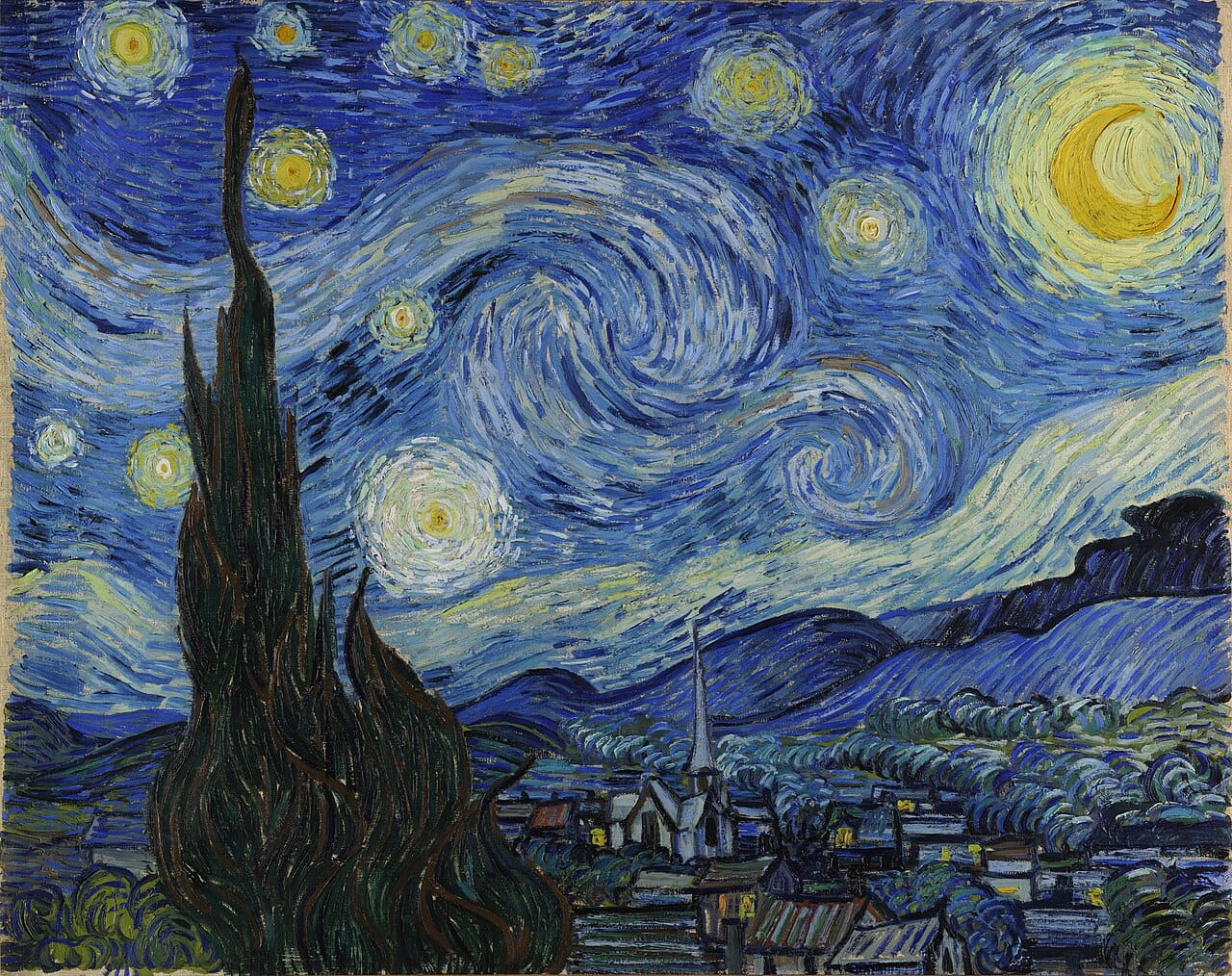
In I Am a Strange Loop, physicist, computer scientist, and philosopher of the mind Douglas Hofstadter’s 2007 follow-up to, among other works, the classic Gödel, Escher, Bach, the author makes a two-pronged argument about consciousness. As an emergent phenomenon, consciousness is a.) real and b.) not best understood at the molecular level. In fact, for most aspects of the human experience and the human meaning-making project, that level is basically meaningless to Hofstadter.
I first came across a version of this idea in astrophysicist Sean Carroll’s The Big Picture, which I read in those dark days after the 2016 election, when I could barely get off the couch and found it strangely comforting to think about life on a cosmic level. Carroll argues for a poetic naturalism, which recognizes that the status of molecules and atoms matters at a certain level of analysis, and that most of human experience does not take place at this level. On one level, Van Gogh’s The Starry Night (1889) is “just a collection of certain atoms in certain locations.” This is an accurate statement. But this, of course, is not how we talk about The Starry Night. Can you understand a painting by noting where each atom is located? Of course not. We talk about The Starry Night by noting that Van Gogh painted it a month into his voluntary yearlong stay in an asylum, that it represents the view outside his window, that it surely reflects something of Van Gogh’s inner state at the time, and thus reveals something of the relationship between the artist and his work.
Hofstadter’s framing of this issue connects beautifully to one of my other abiding intellectual preoccupations: entropy. At its most basic level, entropy is simply the unidirectional movement of heat. It’s most commonly understood as the tendency of all systems to move from highly ordered, low-probability states to disordered, high-probability states. Its end state is equilibrium, aka nothingness, aka the heat death of the universe.
To cyberneticist Norbert Wiener, entropy equated to the loss of information—from the particular, specific, and individual to the generic, nondescript, and anonymous. This, in fact, is why he coined the term cybernetics—which he defined as any system, in animals or machines, that stores, organizes, and learns from the information it receives—and devoted his life to the study thereof. He imagined it as a kind of negative entropy, a way of preventing the information loss that is the fundamental tragedy of mortality.
It’s hard not to empathize with Wiener here. The information loss that accompanies the expiration of the human body—the knowledge, memories, and experiences that make a person—can seem so, well, stupid. Why wouldn’t we want to preserve all that we can, at the most granular level possible? But computer code does not a person make. Even if we could somehow upload all of the information in a loved one’s brain, it would not be that person, or any person. The entire exercise would be meaningless.
The same temptation exists for writers. Surely more is more; surely it is better to include as many facts as possible. But amid all of the information, a story can get lost as easily as a person can. In this way, as in others, at a certain level information is anathema to meaning.
Let’s return to Hofstadter, who knows well that information loss is essential to the meaning-making process. We simply cannot speak at the level of atoms and equations if we want to say, well, anything at all:
We mortals are condemned not to speak at that level of no information loss. We necessarily simplify, and indeed, vastly so. But that sacrifice is also our glory. Drastic simplification is what allows us to reduce situations to their bare bones, to discover abstract essences, to put our fingers on what matters, to understand phenomena at amazingly high levels, to survive reliably in this world, and to formulate literature, art, music, and science.
Think about this, dear reader, when you consider what to preserve—be it of research or of a person. What do we hold onto, and what do we let go? Sometimes information loss is good. Sometimes it is necessary. Sometimes it is the only way to convey meaning.
2026